
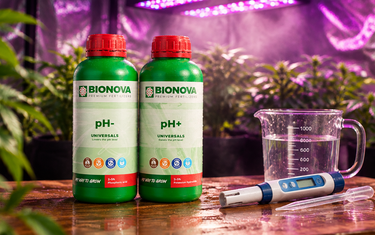
Short answer: The right pH for plants depends on the substrate. Bionova's feeding charts say to adjust the pH of your feed water to about 6.0 to 6.5 in soil, 5.5 to 6.5 in coco, and 5.5 to 6.0 in hydro and aero. Measure the pH after you have mixed in your nutrients, then correct it with pH- or pH+ in small steps. Check again before you feed.

pH is one of the few things in a grow that you can measure in seconds and fix in minutes. It is also one of the most common reasons why plants do not respond to feeding. This guide explains what pH does, which values to aim for in soil, coco and hydro, and how to correct your feed water. It applies to indoor and outdoor plants, including cannabis.
Why pH matters for plants
pH tells you how acid or alkaline your water or root zone is. Plants take up nutrients as dissolved ions, and the pH decides how well each nutrient can dissolve and be absorbed.
Bionova explains it simply: plants only absorb all nutrients when they are applied at the correct pH. When your pH is too low or too high, the plant cannot take up all nutrients, even if they are in the water.
This is called nutrient lockout. It often looks like several deficiencies at once, and adding more nutrients does not fix it. The fix is to correct the pH first.
The right pH for plants in soil, coco and hydro
Each substrate has its own range. These values come from the Bionova feeding charts. The charts give a target of about ("±") these numbers, so small differences are normal.
| Substrate | Target pH of the feed water |
|---|---|
| Soil | ± 6.0 – 6.5 |
| Coco | ± 5.5 – 6.5 |
| Hydro | ± 5.5 – 6.0 |
| Aero | ± 5.5 – 6.0 |
Soil needs a higher range than hydro because soil is a buffered system with a lot of organic matter. In hydro and aero there is no buffer, so the water you give is what the roots see. Read the full tips in the feeding charts for your substrate. Our guide on how to read a feeding chart explains how to use them.
Step 1: Measure the pH correctly
Follow the same routine every time.
- Mix your nutrients and stimulators in the water first. Nutrients change the pH, so measure last.
- Stir well and wait a minute for the reading to settle.
- Measure with a clean, calibrated pH meter. Rinse the probe with clean water after each use.
- Write the number down, together with the date and what you added.
Measure the runoff as well as the feed. Runoff shows what is happening in the root zone, and it can differ from your feed water.
Step 2: Decide if your pH is too high or too low
Compare your reading with the target for your substrate in the table above.
- Too high: this is common with hard tap water, which is typical in much of Europe. Use pH- to lower it.
- Too low: this is common with soft water or reverse-osmosis (RO) water. Use pH+ to raise it.

Step 3: Correct the pH with pH- or pH+
Bionova pH- is a phosphoric acid solution of 24.5% with a concentration of 1:3000. Bionova pH+ is a potassium hydroxide solution of 24.5%, also at 1:3000. Both have NPK 0-0-0 and are used to adjust the pH of the nutrient solution.
For irrigation, Bionova advises 2 to 4 ml per 10 litres of water, depending on the pH of the solution. How much you need depends on your water, so work in small steps:
- Start with a small amount, below the maximum of 4 ml per 10 litres.
- Stir well and wait a minute.
- Measure again.
- Repeat only if you are still outside the target range.
Never add a large dose at once. If you overshoot, you will need the other product to come back, and the solution gets saltier.
Good to know about pH- and pH+
- Both products are mixable with all Bionova stimulators, minerals, universals and substrates.
- pH- adds phosphorus and pH+ adds potassium. If you need a lot of either, Bionova says you can reduce the dose of your PK booster by 10 to 15%.
- pH- is usable from the first week of growth until one week before harvest. pH+ is usable until two weeks before harvest. Flushing is mandatory.
- pH+ is not suitable as a foliar spray.
When pH is the hidden problem: the pH Lockout Fix Pack
If you feed regularly but still see deficiency signs, check pH before you add anything else. The pH Lockout Fix Pack combines pH-, pH+ and The Missing Link, a fulvic acid that helps nutrient uptake over a wider pH range. This way you can correct your water in both directions. You can find all pH products in the Universals collection.
Yellow or pale leaves can also have other causes. Our guide on calcium deficiency in plants shows how to tell a real shortage from a pH problem.
How to keep pH stable
- Measure pH at every feeding, after mixing all nutrients.
- Calibrate your meter regularly and replace old calibration liquid.
- Check the runoff pH every week, and more often if plants look unhappy.
- In hydro and aero, check the reservoir every day. There is no buffer to protect the roots.
- Change doses and pH in small steps, not in one big move.
- Keep a short log of pH, EC and what you added. It helps you find the cause fast.
FAQ
What is the best pH for plants?
It depends on the substrate. The Bionova feeding charts give about 6.0 to 6.5 for soil, 5.5 to 6.5 for coco, and 5.5 to 6.0 for hydro and aero.
How do I lower the pH of my water?
Use a pH reducer such as Bionova pH-. Add a small amount (the label range is 2 to 4 ml per 10 litres), stir, wait, and measure again. Repeat in small steps until you are in range.
What is pH lockout?
pH lockout means the pH is outside the range where the plant can absorb nutrients. The nutrients are in the water, but the plant cannot take them up. Correct the pH first, then compare your feed with the feeding chart.
Do I need to measure pH in soil too?
Yes. Soil buffers pH better than hydro, but the range still matters. Measure your feed water and check the runoff to see what the roots are getting.
