
Short answer: Yellow leaves on plants usually come from one of five causes: a nitrogen shortage, a magnesium shortage, a trace element shortage, a pH problem that blocks uptake, or overwatering that damages the roots. Look at which leaves turn yellow first and where on the leaf. Then check pH and your watering before you add any nutrient.

Yellow leaves are the most common sign that something is wrong in a grow. The problem is that many causes look alike. If you guess, you can add the wrong nutrient and make things worse. This guide shows the five most common causes of yellow leaves on plants, in the order they are most often the problem, and how to tell them apart. It applies to indoor and outdoor plants, including cannabis.
A note first: this article describes typical patterns. Real plants often show more than one problem at once. Use it as a checklist, not as a final answer.
Step 1: Look at where the yellowing starts
Before you change anything, answer three questions.
- Do the oldest, lowest leaves turn yellow, or the newest growth at the top?
- Is the whole leaf yellow, or are only the areas between the veins yellow?
- Is the root zone wet or dry, and how long ago did you last water?
Old leaves point to nutrients the plant can move around, such as nitrogen and magnesium. New growth points to nutrients that cannot move, such as most trace elements and calcium. A wet root zone and a drooping plant point to water or root problems.
The 5 most common causes, from most to least likely
1. Nitrogen shortage
Nitrogen is part of chlorophyll and proteins. When there is too little, the plant moves it from old leaves to new growth. The oldest, lowest leaves turn pale green and then yellow, often evenly across the whole leaf. Growth slows down.
This is most common in the growth phase, when nitrogen demand is high, and in plants that have been in the same pot for a long time.
2. Magnesium shortage
Magnesium sits at the centre of chlorophyll. A shortage shows on older leaves as yellow areas between the veins while the veins stay green. It is common with RO or very soft water. Read our guide on cal mag for plants for more detail.
3. Trace element shortage
Trace elements such as iron, zinc and manganese are needed in small amounts. They do not move well inside the plant, so the signs show on new growth: pale or yellow young leaves, often with a patchy pattern. See our guide on trace elements for plants.
4. pH problem (nutrient lockout)
If pH in the root zone is outside the range for your substrate, the plant cannot take up nutrients even when they are present. The result looks like several deficiencies at once, and the yellowing often does not follow a clear pattern. Adding more nutrients does not help and can cause burn. This is the cause to rule out first when you feed regularly but still see yellow leaves.
5. Overwatering and root problems
Roots need oxygen. When the substrate stays wet for too long, roots suffocate and cannot take up water or nutrients. The plant droops, leaves turn yellow and growth stops, even though the substrate is wet. If you also see brown, soft roots or a bad smell, the roots are damaged.

How to tell the causes apart
| What you see | Most likely cause | First check |
|---|---|---|
| Oldest leaves pale or yellow all over, slow growth | Nitrogen shortage | Where are you in the feeding chart? |
| Old leaves yellow between green veins | Magnesium shortage | Do you use RO or soft water? |
| New leaves pale, yellow or patchy | Trace element shortage | pH first, then your feed |
| Several signs at once, no clear pattern | pH problem | Measure pH of feed and runoff |
| Drooping plant, wet substrate, yellow leaves | Overwatering or root damage | Lift the pot, check roots and drainage |
This table shows typical patterns, not a guarantee. If two rows fit, work through them from the top of the checklist below.
What to do: check in this order
- Check your water and watering. Is the substrate wet for days? Let it dry back and improve drainage before you change your feed.
- Measure pH. Test your feed water and the runoff. Correct it to the range for your substrate in the feeding chart. For hydro, Bionova states pH 5.5 to 6.0. The pH Lockout Fix Pack contains pH-, pH+ and The Missing Link for this.
- Compare your feed with the feeding chart. Are you giving the dose for your growth phase? Change in small steps.
- Treat the specific shortage. Use only the product that matches the symptom.
- Judge by the new growth. Yellow leaves do not turn green again. Healthy new leaves show that the fix works.
Fixing a nitrogen shortage with N 27
Bionova N 27 is a mineral nitrogen fertilizer with NPK 27-0-0 and a concentration of 1:2000. It is free of chlorides and mixes with all Bionova fertilizers, stimulators, minerals, universals and substrates. In irrigation, use 2.5 to 10 ml per 10 litres as a supplement during growth. For a severe shortage, use a maximum of 10 ml per 10 litres. As a foliar spray, use 2.5 to 5 ml per litre.
Bionova also advises that when you raise nitrogen, you raise calcium and potassium too, so tissues stay strong. Excess nitrogen shows as dark green leaves and slow growth, so do not overdo it.
When you are not sure: the SOS Yellow Leaves Pack
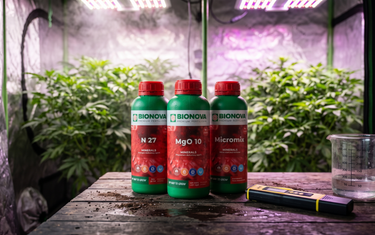
If you cannot pinpoint the cause, the SOS Yellow Leaves Pack contains N 27, MgO 10 and Micromix, which cover the three nutrient causes above. Start with the product that matches your symptom. If the roots are the problem, look at the Root Rot Recovery Pack instead. You can find more bundles in the product packs collection. For help with doses, read how to read a feeding chart.
How to prevent yellow leaves
- Measure pH and EC at every feeding, not only when something looks wrong.
- Follow the feeding chart for your substrate and change doses in small steps.
- Water only when the substrate needs it, and keep drainage open.
- With RO or soft water, plan for calcium and magnesium from the start.
- Keep a short log of feed, pH and watering, so you can find the cause quickly.
FAQ
Why are my plant leaves turning yellow?
The most common causes are a nitrogen shortage, a magnesium shortage, a trace element shortage, a pH problem or overwatering. Check which leaves are affected first and measure pH before you add any nutrient.
Is yellowing from the bottom up always nitrogen deficiency?
No. Nitrogen is the most common reason, but old leaves also turn yellow with a magnesium shortage, a pH problem or root damage. Yellow all over points to nitrogen. Yellow between green veins points to magnesium.
Can overwatering cause yellow leaves?
Yes. Wet substrate cuts off oxygen to the roots. The roots then cannot take up water or nutrients, and the leaves turn yellow even if you feed correctly.
Will yellow leaves turn green again?
Usually not. Leaves that have lost chlorophyll rarely recover. Judge the fix by the new growth, which should come in healthy green.
