
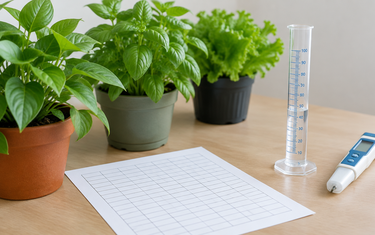
Short answer: A feeding chart tells you what to add to your water in each week of your grow. Pick the chart for your substrate, follow the weeks from the start, and measure the EC and pH of your mix. Start at the low end of the range, and adjust only when your plants show you a reason to.
If you search for a feeding chart, you want a clear schedule you can follow. This guide explains how to read the Bionova feeding charts, what each column means, and when it makes sense to deviate. The numbers always come from the official charts, so open the chart for your substrate next to this article: Bionova feeding charts.
What a feeding chart shows
A feeding chart is a schedule per substrate. It lists your products, the phase or week of your grow, and the amount to add per litre or per 10 litres of water. Some charts also give a target EC.
Bionova has separate charts for Soil, Coco, Hydro, Aero and Vegan growing, and a separate chart for Autoflower. The substrate decides how nutrients reach the roots, so the chart for soil is not the chart for coco.
Step 1: choose the chart for your substrate
Use the chart that matches what your roots grow in. Do not mix charts. A hydro plant takes up nutrients directly from the water, while soil can buffer and store part of them.
If you grow in a mix of substrates, follow the chart of the part that holds most of your roots. If you grow autoflowers, use the Autoflower chart. You can read our autoflower feeding guide for the background.
Step 2: find your phase or week
Charts are built around the grow cycle: seedling or cutting, growth (vegetative), early bloom and late bloom. Count the weeks from the day you start the plant, not from the day you buy nutrients.
If your plant is behind or ahead of the schedule, follow the stage of the plant, not the date. A plant that is still in growth after the chart moves on does not need bloom nutrients yet.
Step 3: read the amounts and units
Check the unit before you measure. Charts use millilitres per litre or per 10 litres. A mistake of a factor 10 is the most common reason for burnt leaf tips.
Add the products in the order given on the chart and stir between each product. Do not mix concentrated products directly with each other. Always dilute in water first.
Our products are highly concentrated, so the amounts are small. Measure with a syringe or measuring cup, not by eye. If a value is not on the chart, see the feeding chart or ask us before you guess.
Step 4: check EC and pH
EC shows how much dissolved nutrient is in your water. pH shows if the roots can take those nutrients up. The chart gives you the recipe, but your tap water is part of the recipe.
Measure your tap water first. Hard water already contains minerals, so your final EC is higher than the nutrients alone. Then add your products and measure again. Correct your pH after adding nutrients, not before. Use pH+ or pH- (see the universals collection) for the correction.
When to deviate from the feeding chart
A chart is a starting point for an average plant in average conditions. These are the situations where it is reasonable to change it:
- Young or weak plants: start at the lower end of the range and build up.
- Very hard or very soft water: adjust your base, and check if you need extra calcium or magnesium. See Ca 15.
- Heat and low humidity: plants drink more water than nutrients, so the EC in the root zone rises. A lower strength can help.
- Runoff EC much higher than your input: salts build up. Give plain pH-adjusted water for a feeding.
- Strong, dark green plants with burnt tips: reduce the strength by a step.
Change one thing at a time and wait several days before you judge the result. If you change three things, you do not know which one worked.
Common mistakes
Skipping weeks to catch up is a mistake. Jumping to full strength in week one is another. Both stress the plant.
Another mistake is feeding by colour alone. Pale leaves can mean too little food, but also a pH problem or overwatering. Check EC and pH before you add more nutrients.
Which product to start with
Your main fertilizer carries the plant through the cycle. For hydro growers this is Nutri Forte A+B Hydro, for coco growers Coco Forte A+B. Browse all main fertilizers, or choose your substrate collection: soil, hydro, coco.
FAQ
What is the difference between a feeding chart and a feeding schedule?
They mean the same thing. Both list which products to use, in which amount, in which week of your grow.
Can I use one feeding chart for all my plants?
Only if they grow in the same substrate and are in the same phase. Use a separate chart for each substrate.
What EC should I aim for each week?
Use the EC given in the chart for your substrate and week. If the chart gives no value, see the feeding chart or measure your plants' reaction at a lower strength first.
When should I feed less than the chart says?
Feed less when plants are young, leaf tips burn, your tap water already has a high EC, or runoff EC keeps rising.
